

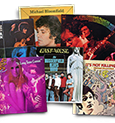

Biography
RECORDINGS
VIDEOS
RICH KID
The son of a wealthy restaurant supply manufacturer, Michael Bloomfield was meant to go into the family business. Instead, he became the country's first great blues-rock guitar master.
BIOGRAPHY
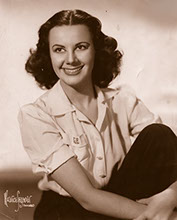 Model and actress Dorothy "Dottie" Klein, circa 1940, prior to her marriage to Harold Bloomfield. Photo courtesy of Allen BloomfieldMICHAEL BLOOMFIELD was born into an upper-middleclass family on July 28, 1943 in Chicago, Illinois. He was the elder of two sons of Dorothy Klein Bloomfield and Harold Bloomfield. Dorothy was a former actress and Miss Illinois runner-up, and Michael's father, Harold, was a partner with his brother in a food service equipment business, a company that would later become part of the industry giant, Beatrice Foods. The family lived in several locations on the north side of the Chicago and, as Harold's business prospered, eventually moved into an apartment building on Melrose Street, just a block from the wealthy residences along Lake Shore Drive.
When he was twelve, Bloomfield's parents decided to leave the city and move to Glencoe, an upscale 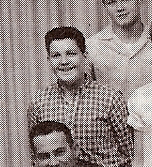 New Trier H.S. sophomore Michael Bloomfield. Photo from NTHS yearbookbedroom community of stately homes and green lawns on Lake Michigan's North Shore. Michael immediately felt like an outcast in the competitive, preppy environment that prevailed in the suburbs. An indifferent student at best, he soon began having trouble at school and was getting into mischief around the neighborhood. It was only after he received a guitar – a 3/4-size Harmony – that he found a place to focus his adolescent energies. His cousin, Chucky Bloomfield, had gotten one and Michael pestered his parents until he was given one, too.
Dorothy arranged for Michael to take lessons with her hairdresser, Tony Tenaglia, who performed under the name Tony Carmen. The adolescent learned show tunes and chords at first, and spent all his time in his room practicing with fake books.
By seventeen, Bloomfield had become proficient enough on his instrument to sit in with his idols in blues clubs on the South Side. He had initially heard the blues of Muddy Waters, Howlin' Wolf and others on the radio, and it wasn't long before he was regularly making the long trip from the North Shore to Chicago's South Side to play with them. While he was tolerated by many in the audience as a novelty – a young white boy climbing onstage with the likes of Muddy Waters was highly unusual – Waters and other musicians recognized that Michael had real talent. They encouraged him, and he in turn absorbed everything he could from them.
Mike Bloomfield jams with fellow students at Cornwall Academy in 1960. Photo courtesy of Rei Reynolds Because he was such an indifferent student – and also a behavior problem – Bloomfield was eventually expelled from New Trier. His father felt he needed a more structured environment, and for the second half of his junior year Michael was shipped off to Cornwall Academy in Great Barrington, MA. A preparatory school with its share of difficult students, Cornwall likely was the place where Michael first encountered drugs.
While school held little interest for Bloomfield, he was becoming deeply involved in music. At the end of the Fifties, Mike Bloomfield found himself caught up in the desire to return to the roots of American music. In 1961, he took up the acoustic guitar and began teaching himself traditional country, bluegrass and rural blues styles.
The University of Chicago on the South Side was a place where young folk and blues enthusiasts congregated, and several, including Elvin Bishop, Nick Gravenites and Mark Naftalin, were students there. One – Paul Butterfield – had attended the university's Lab High School. Butterfield was also gigging around the South Side, performing with black bands as more or less an equal. In 1961, he began playing with Elvin Bishop at Wednesday evening "twist parties" in one of the student dorms. Bloomfield would also occasionally perform at these dances, and it was there that he met Butterfield, Bishop and Naftalin. These twist party jam sessions would form the basis for the Paul Butterfield Blues Band.
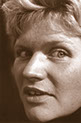 Susan SmithIN SEPTEMBER 1962, Bloomfield married an attractive folk music enthusiast named Susan Smith. And then, in the spring of 1963, Bloomfield met a musician who would play a pivotal role in his career. In April, Bob Dylan came to town to perform at a new folk club, and Michael was immediately charmed by the charismatic, engaging folksinger. Bob, in turn, was deeply impressed by Bloomfield's
 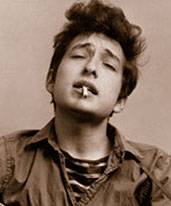 Bob Dylanextraordinary guitar playing and his deep knowledge of traditional tunes and styles. It would be an encounter neither musician would forget.
The following June, Michael began producing a Tuesday night blues series at a coffee house called the Fickle Pickle. He began with Big Joe Williams and – after combing the city's South Side for legendary Bluebird and Okeh recording artists with Big Joe's help – was soon featuring Kokomo Arnold, Arbee Stidham, Tommy McClennan, John Henry Barbee and many other more obscure players. The shows were eventually a huge success with the growing audience of young white folk enthusiasts and college students who were beginning to frequent Old Town, the neighborhood in Chicago where the Fickle Pickle was located.
While Bloomfield was producing shows at the Fickle Pickle, he was also occasionally playing solo gigs around town and had become serious enough about 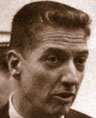 John Hammondmusic that he acquired a manager, a promoter named Joel Harlib.
Harlib was convinced Bloomfield was a major talent and was determined to find him a recording contract. In the winter of 1964, Joel traveled to New York City with a Bloomfield demo and played the tape for Columbia producer John Hammond. Hammond was impressed, and said he might be interested in signing Michael. Bloomfield came to New York City the second week of February 1964 to audition for Hammond at Columbia's midtown studios and was quickly signed to an Epic label deal.
BACK IN CHICAGO, Bloomfield and Charlie Musselwhite began performing regularly at a neighborhood bar in Old Town called Big John's. Charlie had started the gig accompanying Big Joe Williams, but Joe soon left to go on tour and Musselwhite and Bloomfield continued as featured performers. By early fall, Bloomfield had formed a blues band with Musselwhite called The Group and was performing regularly at Big John's.Bloomfield and Charlie Musselwhite performing at Big John's in 1964. Donna Gower photo
It was this band that impresario John Hammond came to Chicago to see. He arranged for The Group to record at Columbia's studios in the Loop, and on December 7, 1964, the band waxed six titles with Michael at the helm. Michael was sure that his big break was imminent.
But John Hammond wasn't so sure. He was dissatisfied with the quality of the recordings The Group made in Chicago, and he decided to get Michael into a studio in New York for a proper session. In March, he arranged for the guitarist to record a second time, this time in Columbia's facilities in the city.
Paul Butterfield was also in New York that spring, recording for Elektra Records. His producer suggested that Bloomfield become a permanent member of Butterfield's group. Butterfield was amenable, and Michael – even though he was under contract to Epic – was soon a de facto part of the Butterfield Band.
IN JUNE, BLOOMFIELD journeyed again to Columbia's studios in New York City on June 15, this time for a series of sessions with Bob Dylan for "Highway 61 Revisited." Within a few weeks, one of the tunes they recorded, the emblematic "Like a Rolling Stone," was climbing the charts and getting airplay nationwide.
Albert Grossman, Dylan's manager, was interested in acquiring the Paul Butterfield Blues Band as client, and he arranged to have the band appear at the 1965 Newport Folk Festival. The fact that the band played electric instruments was quite controversial – many of the organizers of the festival felt strongly that folk music was inherently an acoustic music. The band's presence at Newport created a stir among the younger musicians, many of whom were familiar with 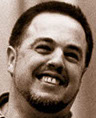 Alan Lomaxtraditional blues but were only vaguely aware of the Chicago version. Everyone was eager to hear them.
The Butterfield Band played its first workshop on July 23, and the performance was introduced by the musicologist Alan Lomax. Lomax felt that authentic blues could not be played by kids barely out of their teens – white kids, at that – and he said as much in his introduction. 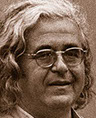 Albert GrossmanFollowing the band's first tune, Grossman confronted Lomax, accusing the folk icon of insulting his clients. The confrontation became heated and the two got into a tussle.
Despite the fisticuffs, the Butterfield Band was huge success. They played a second workshop the following day, and then did a set on the closing night of the festival. Dylan had heard about the excitement surrounding Butterfield's appearances, and he was inspired to recreate the music he had just recorded in the studio with an electric band. He approached Bloomfield, and Michael was willing to do it. The two musicians got busy Saturday afternoon auditioning players for the impromptu performance. Three days shy of his 22nd birthday, Michael Bloomfield was about to secure his place in music history.
When Dylan came out on stage Sunday evening, he brought with him a band that consisted of Michael and two other members of the Butterfield Band – Jerome Arnold and Sam Lay – and Michael's Chicago pal, keyboardist Barry Goldberg. Also joining them was organist Al Kooper. Kooper had also played on Dylan's June recording sessions and had come to the festival as a member of the audience. No one but a few Newport insiders had any idea what Dylan was up to, and the appearance of the troubadour on stage with a crew of musicians caused consternation. And when the band launched into a roaring version of "Maggie's Farm," the crowd's reaction was visceral.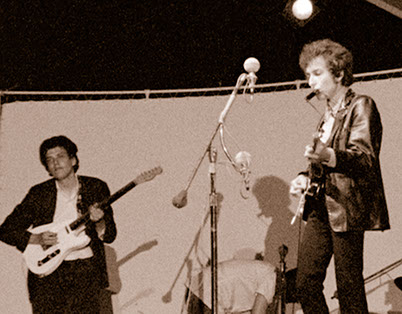 Dylan goes electric at the Newport Folk Festival on Sunday, July 25, 1965, with Mike Bloomfield on guitar. Screen grab from "Festival" by Murray Lerner
Some fans loved it. Others were outraged. The music was loud – loud enough to drown out Dylan's lyrics – and, worse, it was aggressive. At the center of that volume and aggression was Michael Bloomfield's overpowering guitar. Dylan's "rock" band played two more tunes and then they left the stage.
The audience, stunned at first, raised a cry of "More!" And many booed the performance, outraged that their idol had not done his usual set with acoustic guitar and harmonica, and frustrated that his all-important words were all but unintelligible. To appease them, Dylan returned and sang two of his acoustic tunes solo. One – "It's All Over Now, Baby Blue" – aptly said it all.
FOLLOWING NEWPORT, the Butterfield Band returned to New York City and the Café Au Go Go. And Michael was back in the studio with Dylan, recording additional tunes for "Highway 61 Revisited." Albert Grossman was eager to arrange a tour for the songwriter in support of the new album, but Michael chose to play the blues with Butterfield. He rightfully sensed that joining Dylan would mean his playing would take a subservient role.
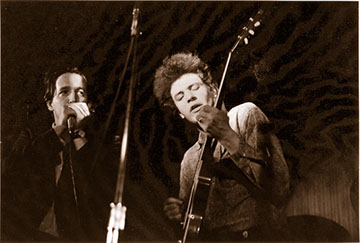 Paul Butterfield and Michael Bloomfield perform at the Cafe Au Go Go in New York City in 1966. Photo by Don Paulsen for Hit ParaderIn September, the Butterfield Blues Band was in the studio, re-recording their album for Elektra for the third time. They then began a rigorous schedule of touring in the fall of 1965. The album, "The Paul Butterfield Blues Band," was released in October and quickly became a favorite on college campuses. The band had month-long stays in Chicago and Boston before heading to the West Coast in late December. On January 2, 1966, they opened at The Trip in Hollywood, and in March brought their hard-edged Chicago blues to the Fillmore Auditorium in San Francisco. With drummer Billy Davenport now driving the band, and Paul and Michael trading fiery solos, people were astonished. The Butterfield Band was a hit.
After a second weekend of performances at the Fillmore in April, the group journeyed cross-country for a few weeks in New York City at the Café Au Go Go. Michael had been wowing crowds wherever the band went with his evermore adventurous soloing, and one tune the band played was a perfect vehicle for displaying his prodigious technique. Called "East-West," it was a composition that Michael had developed out of a tune by Nick Gravenites called "It's About Time," a piece he and Nick had played at Magoo's in Chicago. Built around an ostinato bass part, "East-West" consisted of a succession of intense improvisations by each member of the band, solos that were punctuated by roaring crescendos. The piece culminated in a series of lengthy solos by Bloomfield in a variety of modes.
The band's fans loved it. The term "psychedelic" had been coined on the heels of the LSD craze, and "East-West" seemed to define it. And Michael would further blow minds by occasionally eating fire in mid-performance. He was rapidly becoming known as one of the best and most exciting rock guitarists on the scene.
But that summer in New York City, Bloomfield had a startling experience. For the first time, he encountered a guitarist who was as good as he was.
PLAYING AT THE Café Wha?, just a few blocks from the Café Au Go Go, was a rag-tag band called Jimmy James and the Blue Flames. Singer John Hammond had urged Michael to check out James, and Bloomfield and a friend stopped by to see the show. Michael quickly 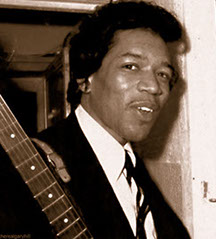 Jimi Hendrix, known as Jimmy James, just prior to forming the Blue Flames and appearing at Cafe Wha? in 1966. Unknown photographerrealized he had seen the slender guitarist before – as an inconspicuous member of the Isley Brothers rhythm section. Bloomfield hadn't been impressed by him then, but now he was amazed! Jimmy James, who would soon be known far and wide by his given name, Hendrix, was using feedback and distortion as musical devices, and was exhibiting a command of his instrument that was staggering.
Meanwhile, the Butterfield Band had been logging time in the studio for Elektra, recording tunes for their follow-up album. In May they were in Chicago, working on capturing "East-West" at the legendary Chess Studios at 2120 S. Michigan. The piece clocked in at over thirteen minutes, even in edited form, and was unlike anything previously recorded by a pop group. Though less adventurous than the versions the band played live, the studio take of "East-West" was still a formidable display musical risk-taking. Central to it were Michael Bloomfield's complex solos, but the band's tight ensemble sound was also integral to its overall success. Mike described it as "pseudo jazz."
In August, Elektra released "East-West," the second album by the Paul Butterfield Blues Band. The album was a mixed bag of blues, pop tunes and two tour-de-force instrumentals – the title track and a jazz standard by Nat Adderley called "Work Song." Guitarists with aspirations immediately took note, and the burgeoning underground music scene was suitably transfixed.
On October 17, the Paul Butterfield Blues Band arrived in London for the start of a tour of the British Isles. In a press conference given at Ronnie Scott's jazz club, Michael spoke enthusiastically about English guitarist Eric Clapton and said he wished he could play as well as his British counterpart. It was Clapton's work as a member of John Mayall's Bluesbreakers that had really impressed Bloomfield. Michael said he was eager to get the same equipment as Eric so that he too could get Clapton's tone.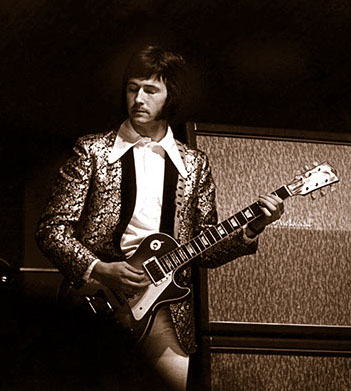 Eric Clapton solos during the debut of Cream at the National Jazz & Blues Festival in London, 1966. Photo by Michael Putland
The Butterfield Band embarked on a series of concert dates the following Thursday, mostly taking day trips to theaters in towns throughout England and Scotland. They were a part of a package tour headed by the Georgie Fame and Chris Farlowe groups.
On October 22, Michael met Eric Clapton for the first time. Clapton was gigging with his new band, Cream, at Leeds University, and the Fame tour came to town to play the Odeon Theater. Butterfield's crew met the members of Cream between the trio's sets at the university, and Michael and Eric spent a few minutes jamming together backstage. Bloomfield noted with envy that Clapton was playing a Les Paul Standard –
a Sunburst model.
BLOOMFIELD CHRONOLOGY continued
ON RECORD
Michael Bloomfield pioneered the sound of blues-rock on numerous recording sessions. Here is a detailed listing of many of those releases.
RECORDINGS
1963-66

LIVE IN '63
J.B. Lenoir & Sunnyland Slim Fuel 2000
Sunnyland Slim, p, v; J.B. Lenoir, g, v; Michael Bloomfield, g; others.
Chicago, IL; 1963
(Bloomfield plays only on a few of these titles.)
Harlem Can't Be Heaven
I Want to Know
It's You Baby
Brown Skin Woman
Lend Me Your Love
J.B.'s Harp-Rack Blues
Piney Brown Blues
For You, My Love
My Dear Old Mother
I Had My Trouble
J.L.'s Blues
Everything's Gonna Be Alright
That's All Right
Louise
Mojo Boogie
The Devil Is a Busy Man
Worried Life Blues
Sunnyland Blues

RARE PERFORMANCES
Michael Bloomfield
Miller Freeman Books
*Michael Bloomfield, g, v.
Norman Dayron’s apartment, Chicago, IL; January 28, 1964
+Michael Bloomfield, g; Michael Johnson, g; Sid Warner, b;
Norm Mayell, d.
Big John’s, Chicago, IL;
October 15, 1964
++Michael Bloomfield, g; Michael Johnson, g; Charlie Musselwhite, hca; Sid Warner, b; Norm Mayell, d.
Big John’s, Chicago, IL;
October 15, 1964
**Michael Bloomfield, p.
Big John’s, Chicago IL;
October 15(?), 1964
Recordings by Norman Dayron, issued with “If You Love These Blues,” a book by Wolkin & Keenom, Miller Freeman Books, 2000
Bullet Rag*
Kingpin*
J.P. Morgan*
Last Night *
Blues for Roy+
Country Boy+
Intermission Blues**
Gotta Call Susie++

DON'T SAY I AIN'T YOUR MAN
Michael Bloomfield
Sony/Legacy
*The Group: Michael Bloomfield, g, v; Michael Johnson, g; Brian Friedman, p; Charlie Musselwhite, hca; Sid Warner, b; Norm Mayell, d.
Columbia Studio A, Chicago, IL; December 7, 1964*; March 1, 1965+; other dates through 1969
(Includes other previously issued sessions from Butterfield Blues Band, Electric Flag, Michael Bloomfield/Al Kooper, Michael Bloomfield & Friends, Nick Gravenites.)
I Feel So Good*
Goin’ Down Slow*
I’ve Got You In the Palm Of My Hand*
Last Night *
I Got My Mojo Working+
Born in Chicago
Work Song
Killing Floor
Albert's Shuffle
Stop
Mary Ann
Don't Throw Your Love on Me So Strong
Don't Think About It Baby
It Takes Time
Carmelita Skiffle

THE ORIGINAL LOST
ELEKTRA SESSIONS
Paul Butterfield Blues Band
Elektra
Paul Butterfield, v, hca; Michael Bloomfield, g, org, p; Elvin Bishop, g; Jerome Arnold, b;
Sam Lay, d.
New York, NY; Winter 1964
Good Morning Little Schoolgirl
Just to Be With You
Help Me
Hate to See You Go
Poor Boy
Nut Popper #1
Everything’s Gonna Be All Right
Rock Me
It Hurts Me Too
Our Love Is Driftin’
Take Me Back Baby
Mellow Down Easy
Ain’t No Need to Go No Further
Love Her With a Feeling
Piney Brown Blues
That’s All Right
Goin’ Down Slow

THE PAUL BUTTERFIELD
BLUES BAND
Paul Butterfield Blues Band
Elektra
Paul Butterfield, v, hca; Michael Bloomfield, g; Elvin Bishop, g; Mark Naftalin, org; Jerome Arnold, b; Sam Lay, d, v.
New York, NY; September 9, other dates, 1965
Shake Your Money Maker
Born in Chicago
Blues with a Feeling
Thank You Mr. Poobah
I Got My Mojo Working
Mellow Down Easy
Last Night
Screamin’
Our Love Is Drifting
Mystery Train
Look Over Yonder’s Wall

HIGHWAY 61 REVISITED
Bob Dylan
Columbia
Bob Dylan, v, g, hca; Al Gorgoni, Michael Bloomfield, g; Al Kooper, org; Frank Owens, Paul Griffin, p; Russ Savakus, Joseph Macho, Jr., Harvey Brooks, b; Bobby Gregg, Sam Lay, d; Bruce Langhorne, tamb.
New York, NY; June 15, 16, July 29, 30, August 2, 1965
Like A Rolling Stone
Tombstone Blues
It Takes A Lot To Laugh, It Takes A Train To Cry
From A Buick 6
Ballad Of A Thin Man
Queen Jane Approximately
Highway 61 Revisited
Just Like Tom Thumb's Blues
Desolation Row

EAST-WEST LIVE
Paul Butterfield Blues Band Winner 447
Paul Butterfield, v, hca; Michael Bloomfield, g, org, p; Elvin Bishop, g; Jerome Arnold, b; Billy Davenport, d.
Hollywood, CA, Chicago, IL, Huntington Beach, CA; 1966-1967
East-West #1
East-West #2
East-West #3
EAST-WEST
Paul Butterfield Blues Band
Elektra
Paul Butterfield, v, hca; Michael Bloomfield, g, org, p; Elvin Bishop, g; Jerome Arnold, b; Billy Davenport, d.
Los Angeles, CA; Chicago, IL; Feb., May, July 1966
Walkin’ Blues
Get Out of My Life, Woman
I Got A Mind to Give Up Living
All These Blues
Work Song
Mary, Mary
Two Trains Running
Never Say No
East-West
1967-69

CHERRY RED
Eddie "Cleanhead" Vinson
Bluesway
Vinson, as, v; Buddy Lucas, ts, hca; Michael Bloomfield*, g; Patti Bown, p, org; unknown g, b, d.
New York, NY; March 1967
Cherry Red
Cadillac Blues
Juice Head Baby*
Alimony Blues*
Somebody’s Got to Go
Flat Broke Blues*
Old Maid Got Married
Workin’ Blues
Wee Baby Blues
Good Night Baby Blues

SOUNDTRACK TO "THE TRIP"
Electric Flag
Sidewalk
Michael Bloomfield, g, v; Barry Goldberg, org, p, hrpscd; Harvey Brooks, b; Buddy Miles, d, perc; Marcus Doubleday, tp; Peter Strazza, ts; Nick Gravenites, v, g; Paul Beaver, moog syn; Bobby Notkoff, el viol.
Los Angeles, CA; April, May 1967
Peter’s Trip
Joint Passing
Psyche Soap
M-23
Synesthesia
A Little Head
Hobbit
Inner Pocket
Fewghh
Green and Gold
The Other Ed Norton
Flash, Bam, Pow
Home Room
Peter Gets Off
Practice Music
Fine Jung Thing
Senior Citizen
Gettin' Hard

A LONG TIME COMIN'
Electric Flag
Columbia
Michael Bloomfield, g, v; Barry Goldberg, org; Harvey Brooks, b; Buddy Miles, d, v; Marcus Doubleday, tp; Peter Strazza, ts; Herbie Rich, bar; Nick Gravenites, v; plus Richie Havens, sitar; Paul Beaver, moog syn; Bobby Notkoff, Julius Held, Leo Daruczek, George Brown, Charles McCracken, vi; Sivuca, g.
Columbia Studios, Los Angeles, CA, New York, NY; July, Sept., Dec. 1967; January 1968
Groovin’ Is Easy
Over-Lovin’ You
She Should Have Just
Sittin’ in Circles
You Don’t Realize
Killing Floor
Texas
Another Country
Wine
Easy Rider

THE BEST OF THE
ELECTRIC FLAG
Electric Flag
Columbia
Michael Bloomfield, g, v; Barry Goldberg, Michael Fonfara, org; Harvey Brooks, b; Buddy Miles, d, v; Marcus Doubleday, tp; Peter Strazza, ts; Herbie Rich, bar; Nick Gravenites, v; plus Richie Havens, sitar; Paul Beaver, moog syn; Bobby Notkoff, Julius Held, Leo Daruczek, George Brown, Charles McCracken, vi; Sivuca, g.
Monterey Pop Festival, June 17, 1967; Columbia Studios, San Francisco & Los Angeles, CA, New York, NY; July, September, December 1967; January 1968
(This release contains the tunes from "A Long Time Comin'," alternate takes, sessions without Bloomfield and performances from Monterey.)
Groovin’ Is Easy
She Should Have Just
Sittin’ in Circles
You Don’t Realize
Killing Floor
Texas
Another Country
Easy Rider
Movie Music-Improvisation
Soul Searchin'
See to Your Neighbor
With Time There Is Change
Nothing to Do
Hey Little Girl
Drinkin' Wine
The Night Time Is the
Right Time

SUPER SESSION
Al Kooper/Mike Bloomfield/Steve Stills
Columbia
Michael Bloomfield,* Steve Stills, g; Kooper, org, ondioline, v; Barry Goldberg, el p; Harvey Brooks, b; Eddie Hoh, d; unknown horn section.
Los Angeles, CA; May 28, 29, 1968
Albert’s Shuffle*
Stop*
Man’s Temptation*
His Holy Modal Majesty*
Really*
It Takes a Train to Laugh
Season of the Witch
Season of the Witch, remix
You Don't Love Me
Harvey's Tune

THE LIVE ADVENTURES OF MIKE
BLOOMFIELD AND AL KOOPER
Michael Bloomfield/Al Kooper
Columbia
Al Kooper, org, v; Michael Bloomfield, g, v; Roosevelt Gook (Kooper), p; John Kahn, b; Skip Prokop, d; Elvin Bishop,* Carlos Santana,+ g; Paul Simon, v..
Fillmore Auditorium, San Francisco, CA; September 26-28, 1968
Opening Speech
59th Street Bridge Song (Feelin’ Groovy)
I Wonder Who
Her Holy Modal Highness
The Weight
Mary Ann
Together ’Til the End of Time
That’s All Right, Mama
Green Onions
Sonny Boy Williamson+
No More Lonely Nights*
Dear Mr. Fantasy
Don't Throw Your Love on Me So Strong
Finale – Refugee

THE LOST CONCERT TAPES
Michael Bloomfield/Al Kooper
Sony
Al Kooper, org, p, v; Michael Bloomfield, g, v; Johnny Winter*, g, v; Paul Harris, p; Jerry Jemmott, b; John Cresci, d.
Fillmore East, New York, NY; December 13, 1968
Bloomfield’s Introduction
One Way Out
Introduction of Johnny Winter
It’s My Own Fault*
59th Street Bridge Song (Feelin’ Groovy)
Tell Me Partner
That’s All Right, Mama
Together ’Til the End of Time
Don’t Throw Your Love on Me So Strong
Season of the Witch

MY LABORS
Nick Gravenites
Columbia
Michael Bloomfield, g, v; Mark Naftalin, p; Ira Kamin, org; John Kahn, b; Bob Jones, d; Rienol Andino, conga; John Wilmeth, tp; Noel Jewkes, ts; Gerald Oshita, Snooky Flowers, bar; Nick Gravenites, v.
Fillmore West, San Francisco, CA; January 30, 31, 1969
Members of Quicksilver Messenger Service*
San Francisco, 1969
Killing My Love
Gypsy Good Time
Holy Moly
Moon Tune
Wintry Country Side
Throw Your Dog a Bone*
My Labors*
Good as You've Been to This World*

Live at Bill Graham’s
Fillmore West
Michael Bloomfield & Friends
Columbia
Michael Bloomfield, Jesse Ed Davis,* g, v; Mark Naftalin, p; Ira Kamin, org; John Kahn, b; Bob Jones, d; Rienol Andino, conga; John Wilmeth, tp; Noel Jewkes, ts; Gerald Oshita, Snooky Flowers, bar; Nick Gravenites, v; Taj Mahal,* v, hca.
Fillmore West, San Francisco, CA; January 30, 31, 1969
It Takes Time
Oh, Mama
Love Got Me
Blues on the Westside
One More Mile to Go*
It’s About Time
Carmelita Skiffle

FATHERS AND SONS
Muddy Waters & Friends
Chess
Muddy Waters, g, v; Phil Upchurch, Michael Bloomfield, Paul Asbell, g; Jeff Carp, Paul Butterfield, hca; Duck Dunn, b; Sam Lay, Buddy Miles, d.
Chicago, IL; April 21-23, 1969; Civic Auditorium, Chicago, IL; April 24, 1969
All Aboard
Mean Disposition
Blow Wind, Blow
Can’t Lose What You Ain’t Never Had
Walkin’ Through the Park
40 Days and 40 Nights
Standin’ Round Cryin’
I’m Ready
24 Hours
Sugar Sweet
Sad Letter
Country Boy
Oh Yeah
Someday Baby
Live the Life I Love
I Feel So Good
Long Distance Call
Baby, Please Don’t Go
Honey Bee
The Same Thing
Got My Mojo Workin,’
Parts 1 & 2

IT'S NOT KILLING ME
Michael Bloomfield
Columbia
Michael Bloomfield, g, p, v; Fred Olsen, g; Michael Melford, g, mandolin, v; Orville Rhodes, pdl stl g; Ira Kamin, org; Mark Naftalin, p; Roy Ruby, p; Richard Santi, acc; John Kahn, b; Bob Jones, d, v; Marcus Doubleday, tp; Ron Stallings, as; Mark Teel, ts; Gerald Oshita, bar; Nick Gravenites, Diane Tribuno, Ace of Cups, v.
Los Angeles and San Francisco, CA; May 19, other dates, 1969
If You See My Baby
For Anyone You Meet
Good Old Guy
Far Too Many Nights
It’s Not Killing Me
Next Time You See Me
Michael’s Lament
Why Must My Baby
The Ones I Loved Are Gone
Don’t Think About It, Baby
Goofers

WEEDS
Brewer & Shipley
Kama Sutra
Michael Brewer, Tom Shipley, v, g; Michael Bloomfield,* g; Fred Olsen, g; Orville Rhodes, pdl stl g; Mark Naftalin, Nicky Hopkins, p; Ira Kamin, org; Richard Greene, vi; John Kahn, Robert Huberman, b; Bob Jones, d; Rienol Andino, conga; Nick Gravenites, v.
San Francisco, CA; 1969
Lady Like You
Rise Up (Easy Rider)
Boomerang
Indian Summer
All Along the Watchtower *
People Love Each Other
Pigs Head*
Oh Sweet Lady
Too Soon Tomorrow
Wichi-Tai-To*

GOT DEM OL' KOZMIC BLUES AGAIN, MAMA!
Janis Joplin
Columbia
Janis Joplin, v; Michael Bloomfield, prod, g*; Richard Kermode, org; Brad Campbell, b; Maury Baker or Louie Castille, d; Luis Gasca, tp; Terry Clements, ts; Snooky Flowers, bar; Nick Gravenites, prod.
New York, NY; June 16-26, 1969
Try
One Good Man*
Maybe*
As Good As You've Been to This World
To Love Somebody*
Kozmic Blues
Little Girl Blue
Work Me, Lord*

TWO JEWS BLUES
Barry Goldberg and ...
Buddah
Goldberg, p, org, v; Michael Bloomfield, g; Eddie Hinton, g; Charlie Musselwhite, hca; David Hood, b; Eddie Hoh, d; Peter Strazza, ts; Mick Weiser, v; unknown horn section, vocal group.
Los Angeles, CA; Spring 1968
(Bloomfield does not play on the other titles on this album.)
That’s Alright, Mama
Maxwell Street Shuffle
Blues for Barry and ... (Dedicated to Big John’s)
Jimi the Fox (Dedicated to
Jimi Hendrix)

NOTHIN' BUT THE BLUES
Barry Goldberg & Friends
Laser Light
Barry Goldberg, org; Michael Bloomfield*, g, v; Harvey Mandel, g; Roy Ruby, b; Eddie Hoh, d;
Bob Greenspan, v.
Shrine Auditorium, Los Angeles, CA; 1969
Los Angeles and San Francisco, CA; May 19, other dates, 1969
(Bloomfield does not play on the other titles on this CD.)
Sweet Home Chicago*
Long Hard Journey (One More Mile)*
CONTACT | ©2019 ALL RIGHTS RESERVED
MICHAEL BLOOMFIELD | AN AMERICAN GUITARIST