
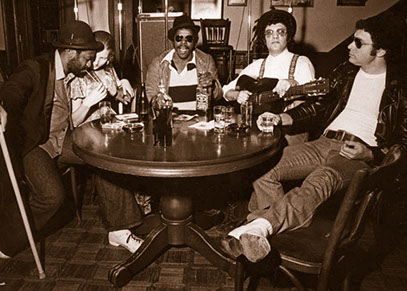
Michael Bloomfield, holding the guitar, with friends at the Keystone Berkeley in 1979. Guitarist Mike Henderson is seated left while producer Norman Dayron is on the right. Photo courtesy of Norman Dayron
THE PROBLEM WAS that nobody outside of the San Francisco area knew the Mike Bloomfield of the '70s. In fans' minds across the country and around the world, he was still the Bloomfield of 1969. That would have to change, but no major label would take a chance on an artist whose recent history included so many commercial debacles.
It was longtime friend, Norman Dayron, who held the solution to Michael's lack of visibility. Dayron was a gifted and experienced sound engineer, and Michael suggested that they produce recordings together and market the tapes to small labels for production and distribution. They would use local recording facilities for a fraction of the cost of the majors, do sessions for scale with friends, and then edit and mix the recordings themselves. Each record could be financed by an advance from the record company, and whatever was left over was theirs to keep.
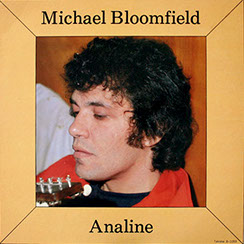 Their first project was for Takoma Records, a small label located in Santa Monica that also issued records by its founder, guitarist John Fahey, and other acoustic players. Michael decided to play most of the instruments himself on a number of originals and standards, and Nick Gravenites contributed one tune. The result, called "Analine" after Nick's composition, was issued in July 1977 and featured Duke Ellington's "Mood Indigo" and Claude Jeter's "At the Cross" along with a few Bloomfield pieces in a variety of blues styles. For the first time, fans could hear Michael playing the music that currently interested him.
Though its distribution was uneven and it didn't receive much promotion, "Analine" was well received by the critics. Of course, they and fans alike still wanted to hear more of the trademark Bloomfield guitar pyrotechnics of days past.
While working on the album, Michael continued to play regularly at the Old Waldorf. For several nights he joined famed Kansas City blues shouter Joe Turner at San Francisco's Palms Cafe. In March, he attended the opening of "Andy Warhol's Bad" in Los Angeles and went to a gala party for its stars at actress Susan Tyrrell's home in Hollywood. Later in the year he took bands on the road to Utah and New York, and at Tulagis in Boulder he premiered a new look for Mike Bloomfield & Friends. For a while, Michael had been billing himself as "Count Talent," and he had been telling interviewers that he was interested in making – of all things – a "disco record." Donning a white suit ala John Travolta in "Saturday Night Fever," he and the band appeared onstage at Tulagis with a horn section and backup singers. They worked through a set of music that included dance tunes he had written for his next recording project – an album to be called "Count Talent & the Originals."
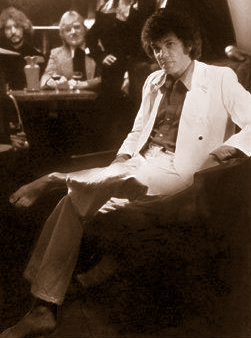 Count TalentMichael and Norman Dayron had convinced Henry Stone of TK Records to foot the bill for a series of full-blown recording sessions. Stone, a veteran of the recording industry, was cashing in on the new dance music fad called "disco," and he gave Bloomfield a huge budget of $50,000 to create an album in that style.
Delighted with their unexpected windfall, Mike and Norman hired a bevy of musicians and spent several weeks recording at a small studio north of San Francisco. The completed album featured an expensive gatefold cover with color photos of the Count and his Originals and a liner with complete song lyrics, detailed notes and extensive credits.
It was hardly a disco record.
In truth, most of the up-tempo tunes evoked '50s rock 'n' roll more than they did the insistent beat of club music. But there was plenty of danceable music on the record, and some good playing, too. And there was Michael in the white suit on the cover.
Needless to say, though, with tune titles like "Sammy Knows How to Party," "Love Walk" and "Let the People Dance," many Bloomfield fans were confused by this latest turn in the guitarist's career. And there were signs that Michael's world was not as together as it may have seemed. "Bad Man," a Bloomfield original, was a bittersweet paean to Michael's rebellious, vital past. "Now I'm not a bad man no more ... I pay my tax, I stay at home and get the door ..." went the tune's refrain. On "You're Changin'," Michael wrote "... turn yourself around, you'll just be a memory if you keep your own self down ... Oh, you're changin' ... It's too much change for me."
INDEED, THINGS WERE changing in Bloomfield's world, and not for the better. For one thing, by 1978 the members of his Reed St. household had all gone separate their ways. Susan and Bonner Beuhler had become romantically involved and had eventually gotten married. When they moved out, they took little Toby with them. Big Toby – Toby Byron – had gone off to work with jazz keyboardist George Duke in New York City. Michael was left to look after himself, and he found that he was playing host to an ever-changing retinue of house guests, hangers-on and transients. He had begun using drugs with more regularity, too, and began missing gigs with increasing frequency. Close friends and longtime musical partners distanced themselves from Michael as his behavior became more erratic and irritating.
But Bloomfield's condition was not entirely of his own making. His long history of insomnia, extreme mood swings and hyperactivity stemmed from what his brother, Allen, has described as a chronic bipolar illness. The disorder was a condition that was not uncommon in the Bloomfield family, and Michael seemed to suffer from an extreme version of it. In the 1970s, not much was understood about bipolar disorder, and there was no real treatment for it. Michael would consult doctors and check into sleep clinics in an effort to relieve the pain and anguish it caused, and he might succeed in mollifying the condition's affects for a while. But the sleeplessness and mania would always return, and it seemed only to increase as the '70s drew to a close. Self-medication became Bloomfield's chief means of escape.
Throughout these increasingly difficult times, Norman Dayron was Mike's closest friend. The two worked together on recording projects, figuring out ways to minimize expenses and maximize returns for both in-studio record deals and live performance recordings – chiefly done during casual sets at the Old Waldorf. Their next production would be another record for Takoma.
A combination of studio and live tunes, the LP featured Michael overdubbing many of the parts himself. Joining him on the Waldorf performances were Bob Jones, Chicago friend and keyboardist Ira Kamin, and Dave Shorey, a multi-talented bass player from Utah who had recently joined & Friends. Like his other Takoma record, this one – titled "Michael Bloomfield" – contained a mix of acoustic and electric blues and gospel pieces in a variety of styles. One selection, however, didn't make it onto the original release. A variation on the pop hit "Cisco Kid," it was an original by Michael sardonically titled "Crisco Kid" that highlighted his growing fascination with taboo sexual practices. Its subject matter concerned gay cruising and anal intercourse, and once Takoma heard its lyrics they declined to let it to be released. "Michael Bloomfield" was issued in the fall of 1978 and once again there was little promotion and less critical notice.
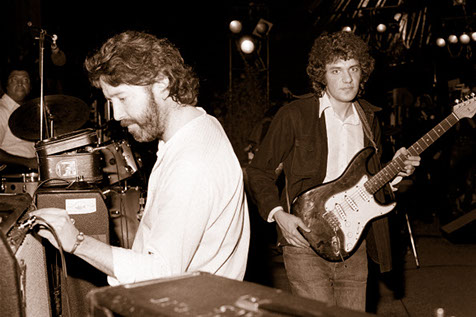 The Butterfield Blues Band reunion at the Tribal Stomp in 1978 brought together the original band with the exception of Jerome Arnold. Here Butterfield and Mike Bloomfield get ready to perform. Unknown photographerIn October, producer Chet Helms organized a "Tribal Stomp," a day-long music extravaganza that featured numerous Bay Area bands. The headlining event was anoither reunion of the original Paul Butterfield Blues Band, and there was much excitement around their appearance. Only Jerome Arnold would be missing from the lineup that originally brought electric Chicago blues to the kids of San Francisco.
Afternoon rehearsals for the reunion went well, with the band finding its old groove and sounding excellent. Michael, however, had been unable to make the practice session and only joined the sextet on stage that evening for the October 1 performance. Things started out well with "Born in Chicago," but eventually Elvin took over the show and Butterfield and Bloomfield seemed to recede into the background. It seemed that old resentments and antagonisms had resurfaced, and the competition between Butterfield's guitarists this time was settled in favor of Elvin. "Remind me never to stand between those two guys. They don't like each other," Paul said of Bloomfield and Bishop that night.
Michael headed east following the Greek Theater show for series of concerts culminating in a weekend at the Bottom Line. His quartet now most often included Mark Naftalin, Dave Shorey and Bob Jones. After gigging locally in San Francisco for a few months, they made a difficult tour of venues in Ontario and Quebec in January. The New Year, 1979, was off to a bumpy start.
MICHAEL BLOOMFIELD'S MENTAL health had become so stressed by mid-1979 that it was difficult to get him to the few gigs he had scheduled. Either Bob Jones or Dave Shorey would have to pick him up at home to make sure that he got to the club on time or to the airport to catch his flight. Once at the venue and onstage, Michael nearly always played well. But the hassle of getting him there was often draining on his sidemen. To complicate matters, Michael had been medicating himself with Placidyl, a drug frequently used in the '70s to treat insomnia. Its overuse often resulted in slurred speech and cognitive lapses, and Bloomfield began experiencing these side effects. By the summer, his use of the medication was so acute that he put himself into a local rehabilitation hospital for an entire month in an effort to overcome his dependency.
When he got out, he began substituting alcohol for the sedative.
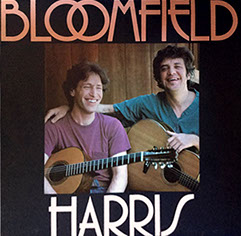
At the about the same time, Mark Naftalin introduced Mike to a young guitar player named Woody Harris. The two hit it off right away over their shared interest in gospel and classic blues styles, and Harris's more sedate, formal approach to guitar playing seemed a perfect complement for Bloomfield's intense, rhythmically complex picking. The two began playing together as a guitar duo, doing traditional gospel pieces that more often than not featured Michael's careening, plaintive slide work.
In July, Michael and Woody spent a couple of days in Norman Dayron's living room recording what would be Bloomfield's next release. It was an album of guitar duets, and as he had done on "If You Love These Blues," Michael took a folkloric approach. The tunes – obscure spiritual and gospel pieces – were given a respectful, straight ahead reading. The album, called "Bloomfield/Harris," came out on the small Kicking Mule label in the fall and was generally well received.
 In the winter of 1979, Michael rekindled his on-again-off-again relationship with dancer Christie Svane, and moved to New York City to be near her. His drinking had become a serious problem by this point, and he often drank iced vodka from a saucer for breakfast. Michael had never liked alcohol, preferring marijuana and other drugs, but now as a drinker he would get "sloppy." Fortunately for those who cared about him, alcohol rarely made him morose or belligerent. But his boozing added fleshy weight to his rangy frame and gave his features an unhealthy, bloated look.
In April 1980, Michael and Woody Harris played a weekend at the Bottom Line and then did shows in Boston at Jonathan Swift's. Joining them for part of their sets was Harris's partner, cellist Maggie Edmondson. They would play traditional gospel and blues material of the type that was featured on "Bloomfield/Harris."
In the summer of 1980, Harris proposed that the trio do a European tour. Michael, never comfortable when he was away from home, viewed the junket with trepidation. But Christie agreed to go along and Bloomfield was convinced to do it. The foursome flew to Italy in September for a tour that would include Mascheroni, Firenze, Naples, Verona and several other cities. Right away anxiety kept Michael from sleeping, and soon his imbibing began to affect his performances. Fans would challenge him to drinking contests and he soon would be in no shape to play.
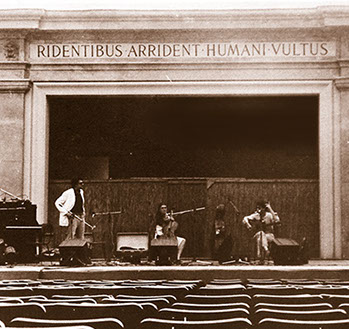 Preparing for an appearance by Bloomfield's collaborative trio in Leghorn, Tuscany, probably on September 9, 1980. Michael is seen standing, while cellist Maggie Edmondson and guitarist Woody Harris tests the mics. Unknown photographerThe tour was difficult for Michael, but he and Harris with Edmondson's help faithfully recreated their duets from the Kicking Mule release, and they were generally well received. But just as often there were cries of "Super Session!" and "Season of the Witch!" The group then flew to Stockholm for a week of shows in Scandinavia. But once there, Bloomfield went on a drinking binge that exceeded anything he'd done previously. Audiences there were more accepting of Michael's traditional blues and gospel repertory, but by the time the tour had concluded he was in terrible shape. When they arrived back in New York, Bloomfield abandoned his instruments at the airport and spent $300 on a cab ride to a friend's home in Connecticut. There he recuperated for a few nights before heading back to San Francisco.
BACK HOME AGAIN, Michael began working on another recording with Norman Dayron for Takoma. This time he concentrated on guitar and piano, and worked with a real rhythm section and horns. But the musicians he enlisted for the session were none of his usual Friends players – they were all new names. Even Bob Jones and Dave Shorey had had enough.
But there was one more surprise in store for Bloomfield fans. Bob Dylan was in town performing at the Warfield Theater, and he invited Michael to sit in on one of his shows. Bloomfield tentatively agreed to come by, and on the night of November 18, he did.
Dylan brought on the man who had helped create his trademark folk-rock sound by saying to the audience at the Warfield that here "was a guitar player who could play circles around anything I could play." After a 10-minute introduction, Dylan launched into a "Like a Rolling Stone" and Michael played his classic fills like it was 1965 all over again. It was a triumphant moment for both musicians, and the crowd gave them a thunderous ovation. It would be the last they would play together.The Warfield Theater in San Francisco where Bloomfield sat in with Bob Dylan in November 1980. Unknown photographer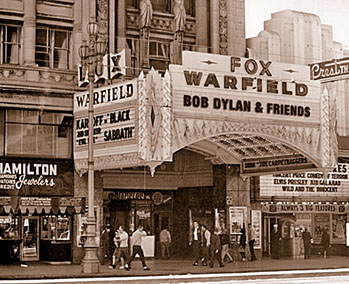
In December, Michael was back on the East Coast for a few more gigs with Harris and Edmondson, and then after the New Year he did several weekends at the Catalyst Club in Santa Cruz. On February 13, producer Tom Yates interviewed Bloomfield on Reed St. for a radio series on guitarists. Throughout their discussion of the blues and its history, Michael was thoughtful and engaged. His commentary on the music he loved and his role in it reflected a deep understanding of not only the American experience but of himself as a person. He did not sound like a person who had only two days to live.
But on February 15, Michael Bloomfield went to a party in San Francisco by himself and was given some sort of drug that caused him to overdose. In an effort to revive him, his hosts injected him with cocaine, and when that failed, he was taken out to his car and driven to a side street where he was left to die. In the morning, his body was discovered in his parked car, and it was shipped to the morgue as an unidentified John Doe.
Michael Bernard Bloomfield, rock legend, master blues stylist, historian, teacher, musical genius, was dead at 37 years of age.
AFTER HIS IDENTITY was established, a funeral service was arranged for Michael at Sinai Memorial Chapel in San Francisco. Friends and family then paid tribute to the fallen guitarist at a memorial gathering at the new Old Waldorf arranged by Bill Graham. The following day, the body was flown to Los Angeles for a second service for the immediate family, and then was interred on February 20. Magazines and newspapers around the world noted Bloomfield's passing, remarking that the once prominent musician had fallen on hard times in recent years. But his roll in the development of modern American blues and rock 'n' roll was also acknowledged. 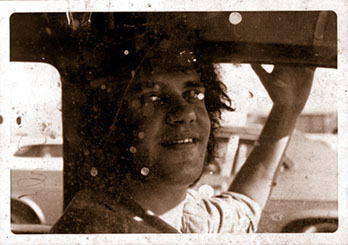 Guitarist Michael Bloomfield at the wheel of one of his cars, in a photo probably taken in the late '70s.
Photo courtesy of Leonard Trupin
CONTACT | ©2019 ALL RIGHTS RESERVED
MICHAEL BLOOMFIELD | AN AMERICAN GUITARIST