THE AUTHOR'S CUT
This website is a supplement to Guitar King: Michael Bloomfield's Life in the Blues, a biography of America's first great blues-rock guitarist. Certain passages were necessarily omitted from the book's nearly 800 pages, due to space limitations. But those passages are offered here as a digital appendix.
'GUITAR KING' BONUS PAGES
BUSTED
The Newport Trip That Wasn't
1963 | By David Dann, supplemental to Guitar King: Michael Bloomfield's Life in the Blues
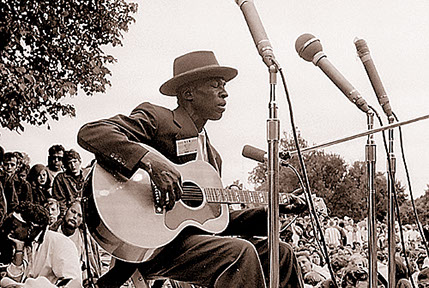 Legendary bluesman Skip James performs at the 1964 Newport Folk Festival. David Gahr photoBUT MICHAEL BLOOMFIELD was more restless than ever. He'd landed a contract with Epic Records and had just done a recording session with singer John Hammond in New York, but still nothing seemed to be happening with his career. And despite his successes at home, Chicago was starting to feel very distant from where things were really happening. Naturally, Bloomfield had a strong desire to be where things were happening.
When they were in the studio together, Hammond had mentioned to Michael that he was going to perform at the Newport Folk Festival in July. He urged Bloomfield to go as well, mentioning that Skip James, Mississippi John Hurt, Fred McDowell and Sleepy John Estes were going to be there. Mike knew that all the major folk labels would also be present along with many East Coast makers-and-shakers, the folk music press and a bevy of managers. If he were there too, Bloomfield reasoned, he might be able to meet some of those people and play for them in person. As far as folk music was concerned, Newport in July was where things were definitely happening.
Indeed, the festival had become the nation's premier annual folk gathering. An offshoot of Newport's successful jazz festival, the Newport Folk Festival had initially been organized in 1959 by jazz club owner and producer George Wein, with the help of Chicago manager Albert Grossman. The original three-day event brought together an extraordinary group of folk performers, offering a wide variety of ethnic and traditional musics performed in both formal concerts and in casual, relaxed workshops. Young stars from the New York and Boston folk scenes were featured right along with elder masters from the Ozarks, Blue Ridge Mountains and the Mississippi Delta. Folk fans could hear traditional Irish music, sea shanties, work songs, bluegrass breakdowns, Appalachian ballads and rural blues all in the space of a weekend. And they could do it while enjoying the sights and sounds of scenic Newport, a summer resort town renowned for its huge mansions and wealthy patrons.
The Newport festival had returned in 1963 after a two-year hiatus and word was the 1964 weekend was going to be even bigger and better than any of the previous festivals. In addition to the blues greats that Hammond mentioned, Johnny Cash, Jesse Fuller, Doc Watson and many other folk masters were scheduled to perform. And Mike’s friend, Bob Dylan, was playing the closing night. It was going to be an amazing weekend of music.
Michael Bloomfield decided he had to go. During the third week in July, he organized a sojourn to Rhode Island. Charlie Musselwhite readily agreed to join him and Michael's frequent traveling companion, Fred Glazer, was also recruited for the trip. The trio planned to leave on Wednesday, July 23, and hoped to arrive in time for the first day of the festival.
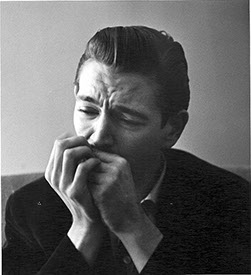 Charlie MusselwhiteNorman Dayron photoThe ride was going to be a long one, and Bloomfield decided they needed a little something to ease them on down the road. Accordingly, he planned to stop off at Mike Allen's apartment to fortify the expedition with several ounces of marijuana. Allen, the driver who had gone on the junket to St. Louis with Big Joe Williams the previous year, usually had a stash of grass. His place was one Bloomfield would regularly visit on his afternoon rounds with Joel Harlib. Occasionally Charlie would join them, and they would all listen to records and share a few joints, courtesy of Mr. Allen.
“Mike loved to go over there and smoke pot,” laughed Musselwhite. “Allen always had a lot – and it didn’t cost us anything!” (1)
Mike Allen also had a car. It had performed admirably during the escapade to St. Louis, and Bloomfield had talked Allen into letting him borrow it again for a trip back east. This time, Michael explained, the destination was going to be Newport.
The three friends planned to drive through the night, taking turns behind the wheel, and arrive in Rhode Island early Thursday afternoon. Bloomfield and Musselwhite would miss the weekend shows at Big John's, but Big Joe could handle those all by himself. The Newport adventure was all set.
* * *
Wednesday morning Michael said goodbye to Susie and met up with Fred and Charlie over at Mike Allen’s basement apartment. They got the keys and a baggie of grass, found the car on the street and loaded their stuff into the trunk. Michael had brought along his Martin guitar so he could do some playing and, at the last minute, Charlie decided he wanted to bring his guitar as well. He headed back down the street to the Old Wells Record Shop to get it, saying he’d meet them in front of the store.
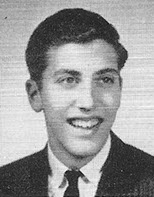 Fred Glazer in 1961Fred slid in behind the wheel, keyed the ignition and adjusted the mirrors. Mike got in beside him, put the bag of marijuana in the glove compartment and jerked the door shut. The car pulled away from the curb and out into traffic. Before Fred had gone more than a few blocks, Michael suddenly twisted around and peered out the back window. He grabbed Fred's arm.
"Michael said, 'Man, we gotta get outta here − those are cops!'," Fred said. Bloomfield had noticed another car following them, a plain sedan with two clean-cut occupants in the front seat. Glazer was confused. "I didn't know there was even such a thing as undercover cops, that's how naive I was. I didn't even know such a thing existed. But Michael did." (2)
The police had been watching Mike Allen's place, staking it out with the intention of collaring any suspicious looking visitors. They suspected Allen was doing a little dealing, and anybody who visited him was of interest to law enforcement. Michael and Fred fit the profile, and the officers decided pursue them.
"I pulled up to a stop sign right by Charlie's house on Wells Street," Fred remembered. "Michael grabbed the bag of pot that we had and started running down the street, you know, swallowing the pot − sort of waddling down the street because he was a little fat guy at the time. The cop ran after him and caught him, you know, shoved him up against the building and made him spit out the pot." (3)
Fred sat in the car, stunned. The other officer went after him.
"He came around to my side and stuck a gun to my head and said, 'Get out of the car!', pulled the door open and grabbed me out," Glazer said. "He searched the car and found another couple of joints."
At that moment, Charlie emerged from the record shop with his guitar. He immediately saw what was happening to his friends and knew what he had to do.
"Charlie sees this happening right in front of him, so he just sort of turns his head the other way and starts whistling, you know, like he didn't know us at all," laughed Fred. "He just walked on down the street, whistling some little song, looking the other way. He just kept on going." (4)
Musselwhite's timing couldn't have been better. Had he not gone for his guitar, he too would have been apprehended. As it was, he was just an innocent bystander. "I just walked on by and then headed over to Mike's apartment in Carl Sandburg Village," said Charlie, not knowing what else to do. "I told Susie over the intercom what had happened." (5)
What had happened was the police nabbed two scruffy-looking drug users who had in their possession a substantial amount of an illegal narcotic. In 1964, that was a very serious offense.
"This was before people knew about pot, the dark days of drugs when people really thought it was bad stuff, you know? Refer madness," explained Glazer. "You were baby killers, child abusers, monsters!" (5)
Demonized over the decades as a potent psychoactive drug that could cause criminal behavior, insanity and even death, marijuana had been legally classified as a "narcotic" since the early 1900s. In 1956, Congress passed a law declaring that possession of even a small amount of the drug incurred a mandatory sentence of two to ten years in prison and a hefty monetary fine.
The two friends were clearly in trouble.
"They thought we were killers! They put cuffs on us, they punched us around, threw us in the back of a van," said Fred, still shaken by the experience many years later. "They told us we were going to get 10 years in jail, that this was a felony and our lives were over!" (6) The officers hauled them off to the local police station.
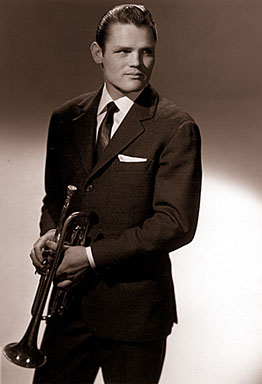 Jazz trumpet player Chet BakerOnce in custody, the young men were booked and questioned. The police could see that Michael and Fred were hardly more than kids, probably just casual reefer smokers and certainly not neighborhood drug lords. But the charge wasn't a light one, and the officers thought that perhaps they could use their captives to good advantage.
"They said, 'You better tell us where you got the dope!'" said Fred. "Michael said, 'Oh, we got it from some musician, some guy over at Mother Blues, some Puerto Rican. I don't know who it was.' So then they asked us about all these different people. They asked us about Chet Baker."
Baker, the famed West Coast jazz trumpet star, was notorious for being a heroin addict. He had recently returned from a long stay in Europe and was touring the United States with his quartet. The band was performing in Chicago that week, and the officers thought they might use Michael and Fred to make a high-profile arrest.
"Chet Baker was a known junkie and they said to us, 'Would you sell him dope? Set him up and let us bust him. If you do that, we'll cut you loose.'" Fred recounted. The deal was tempting, but the friends declined, saying they didn't know anything about Chet Baker. At that point, the cops decided to have a little fun with their captives.
"They kept thinking Michael was some other guy, you know?" said Fred. "They'd say, 'You're Tommy Magioni!' 'No, man, I'm Mike Bloomfield!' 'No, you're Magioni. We know you, you've been wanted for 10 years. You're the biggest dope addict, heroin addict and pot dealer in Chicago. We're gonna get you.' 'No, no − that's really not me!' But no one would believe him." (7)
There were wanted posters hanging on the wall in the station and one suspect's mug shot did indeed look like Michael. The police knew Bloomfield was probably who he said he was, but it was entertaining to watch him squirm. After what seemed like hours, Mike and Fred were finally taken to the lock-up.
"They put us in a cell down in the basement," Fred said. Right away, his friend became agitated. "Michael said, 'Man, I have to get out of here. I don't know about you but I can't take it!' He was totally flipped out, claustrophobic." (8) In a panic, Michael anxiously paced around in circles and pounded his fists against the cell walls. When the two suspects were allowed to make a phone call, Bloomfield pulled out a number he kept in his wallet for emergencies. He called Harold.
"Michael called his father, and his father got a lawyer who came down there and got him out within a couple of hours," said Glazer. Fred was hesitant to tell his dad about his arrest, so he called another family member and made arrangements to get a lawyer through him. "That took like an extra day, so I had to stay overnight," Glazer recalled. "I got to make friends with a few criminals down there." (9)
* * *
Needless to say, a trip to the Newport Folk Festival was off Mike Bloomfield's summer agenda. His father once again was disgusted with his son and, though Michael was grateful to Harold for bailing him out, he hated having to depend on him. He and Fred were charged with criminal possession of a controlled substance and were ordered to appear in court within a few weeks. They were facing a possible prison sentence at worst and repeated court appearances, costly appeals and probable probation at best. It did not look good for Mike Bloomfield's nascent career.
But fate intervened, and Michael and Fred got lucky. By chance, the judge appointed to their case was the liberal Chicago jurist, Judge Kenneth Wendt.
"He was an old Irish judge but he was cool, and he understood that whatever this pot thing was with kids, it was harmless," Fred said. (10)
When the day of their trial arrived, the defendants appeared in court wearing new suits, their hair cut short and their wives on their arms. Each had a high-priced lawyer, and both Michael and Fred appeared to be nice young married men from well-to-do suburban North Shore families − which wasn't far from the truth. The arresting officers sat at the district attorney's table, confident of their case and waiting for the proceedings to begin.
Judge Kenneth Wendt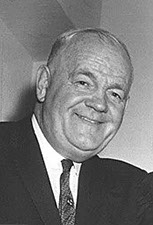 Judge Wendt called the court into session and heard the evidence. Then he addressed the officers.
"We went in there with these cops, you know, and the judge is saying to them, 'Why did you stop these people?'" Glazer remembered with some pleasure. "They said, 'Well, your honor, they had long hair and they were funny looking.' And the judge says, 'My wife has long hair and is funny looking. Are you gonna stop her because she's walking along the street?' 'No, your honor.' 'Well, you have no reason to stop people just because you don't like the way they look. Don't ever come in here again with a case like this. If you do, I'm gonna throw you out of court right on your ass!'"
Judge Wendt dismissed the charges, and just like that Michael Bloomfield got his life and career back.
"He just threw the case out," said Fred. "He said, 'Case dismissed! You guys can go,' and we looked at each other and said, 'What?' Our lawyers just said, 'Quick, get outta here!'" (11)
It was a break neither of the friends had been expecting. They were greatly relieved, though not at all chastised. Neither was about to change his behavior or swear off drugs. For both of them, the issue would lead to repeated entanglements with the authorities. But for Mike Bloomfield, drugs would mean more than just good times. They would become a safe harbor from the emotional storm that raged inside him. For now, though, Michael was just glad to return to his life and his music.
He had just passed his twenty-first birthday.
NOTES
1. Charlie Musselwhite, email to author, 2015
2. Fred Glazer interview with Bill Keenom, 1996
3. Ibid
4. Ibid
5. Charlie Musselwhite, email to author, 2015
6. Fred Glazer interview with Bill Keenom, 1996
7. Ibid
8. Ibid
9. Ibid
10. Ibid
11. Ibid
I BLUESKVARTER
Recording for Swedish radio
1964 | By David Dann, supplemental to Guitar King: Michael Bloomfield's Life in the Blues
Michael Bloomfield plays piano during a session for the Swedish radio program "I Blueskvarter" at Chicago's Sutherland Hotel in 1964. George Mitchell photo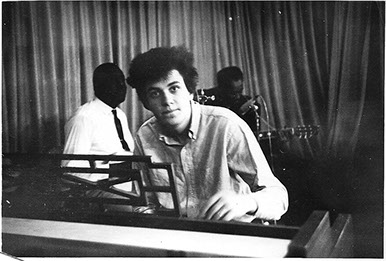 IN MAY, JAZZ RECORD MART OWNER Bob Koester got a call from a radio and television producer he'd met in 1961. Swedish broadcaster Olle Helander was coming back to Chicago to record local musicians for a special radio series he was creating on American blues for the Scandinavian Blues Society. The program, called "I Blueskvarter" (or "In Blues Quarters"), was set to air that fall over Swedish radio and Helander wanted to document as many of the city's blues artists as time and his budget would allow. He contacted Bob, asking him to help organize the sessions. Koester agreed, and enlisted Pete Welding and Chess Records A&R man Willie Dixon for the project. They began recruiting musicians, and Bob asked Michael Bloomfield if he would participate in several of the sessions.
Bloomfield was only too happy to accompany a few of his friends on recordings that would be aired over Swedish radio. The fact that Helander was paying the musicians made the opportunity even more enticing. It never occurred to Michael that because he was under contract to Epic Records, his participation in any recording session − even one for the Swedish Broadcasting Corp. − had to be authorized by his record company. He was just eager to play.
On Saturday afternoon, May 16, Koester picked Michael up at Sandburg Village and drove up LaSalle Street and over to Lake Shore Drive, taking the parkway south to 47th Street and Drexel Boulevard. He parked the car next to the Southerland Hotel, got out and held the door to the Southerland Lounge for Michael and his guitar. Helander, not having the funds to pay for a conventional recording studio, had arranged to rent Chicago's premiere jazz venue for his sessions. He and his sound engineer had set their equipment up on a table in the lounge, and had rearranged the stage to get the best sound. They planned to do five full sessions over the period of a week, capturing Chicago blues stalwarts like Willie Mabon, Washboard Sam, Yank Rachell, Blind Jim Brewer, Arvella Gray, Big Walter Horton, Johnny Young, Little Brother Montgomery and St. Louis Jimmy on tape. Michael knew all of them well.
Saturday was Helander's second day of recording. Koester wanted Bloomfield to back up Eddie Boyd, thinking the young guitarist would be a good fit for the 49-year-old pianist. Boyd had recorded with the original Sonny Boy Williamson, Big Maceo and Tampa Red, and had scored a huge hit with "Five Long Years" in the early 1950s. Since then he'd produced a string of regional bestsellers for Chess Records and was one of the label's regular artists. He played piano in the modern style and had done several shows for Michael at the Fickle Pickle over the previous summer. The guitarist knew just how to accompany him.
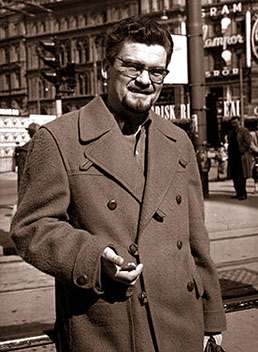 Swedish radio producer Olle HelanderThey recorded five tunes together, including an up-tempo version of "Five Long Years," and Bloomfield, despite the fact that he was playing his Martin, ran through chords and fills in his best electric style. Boyd gave him ample space to solo and Michael displayed his "B.B. King" chops, as Koester described them. In reality, his lead lines and fills more closely resembled those of modern Chicago stylists like Otis Rush, the West Side's Magic Sam, Muddy Waters' guitarist James "Pee Wee" Madison or Robert Jr. Lockwood. If Michael had plugged in and a drummer had been present, Eddie Boyd's performance would have been right at home at Pepper's or the Copa.
After Boyd had completed his five tunes, the engineer rearranged the mics for Yank Rachell. With Rachell was guitarist John Lee Granderson, a Maxwell Street regular who often worked with harmonica player John Wrencher. Granderson's style was more traditional with less emphasis on lead lines, but his basic chords and simple rhythm patterns were an appropriate foil for Rachell's busy mandolin work. Pete Welding had recorded him for Testament and had suggested Granderson for the session, knowing he'd be a suitable accompanist. Koester also wanted Bloomfield to play behind Rachell but after hearing what Michael did with Eddie Boyd, he decided it would be better to have the young guitarist play piano. He didn't want a clash of styles as had happened during Rachell's recent sessions for Delmark.
The trio recorded four songs, three originals by Rachell and a version of B.B. King's "Rock Me Baby" called "My Baby Rocks Me." Kent Records had released King's tune in the spring and it was climbing the R&B charts and all over South Side radio that May. Michael doubtless talked Rachell into trying it, and kicked the tune off on piano with a variation of the original's distinctive beat. Yank sang the lyrics with gusto, incorporating two choruses from Muddy Waters' "I Want You to Love Me," and then during three rounds of solos − one for Granderson and two for himself − stomped his foot with such enthusiasm that he threatened to distort the recording. "Rock me! Rock me, man − rock me!" the charged-up mandolinist shouted at his accompanists.
The song was an odd choice for a blues musician whose style dated to the pre-war acoustic era. But in relegating Bloomfield to piano, Bob Koester doubtless chided Michael for his tendency to play lead ala B.B. King. That must have irritated the young guitarist and, in typical Bloomfield fashion, he paid Koester back by having Rachell himself play B.B. King.
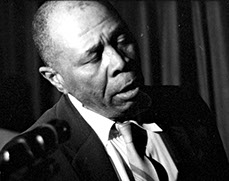 Sunnyland SlimThe following week, Michael returned to the Southerland Lounge for two more sessions, one with Little Brother Montgomery and another backing St. Louis Jimmy and Sunnyland Slim in separate sets. He'd jammed with all three musicians at the Fickle Pickle, but it was Slim that he connected with best. The two romped through six tunes in the modern style, with Sunnyland urging him to "Take it, Mike!" during the solo breaks. The 20-year-old displayed a masterful command of the blues idiom throughout the Swedish radio sessions, but his collaboration with Sunnyland Slim was exemplary. Scandinavian blues fans would not be disappointed.
Michael too was not disappointed. Of all the musicians who participated in Helander's project, Bloomfield was supposed to be the best paid. Where most of the players did only one or two sessions, Mike had been involved in five. As it turned out, though, the promised remuneration never materialized.
“Nice guy, but he never paid anyone,” said Michael of Helander in an interview many years later. He laughed, “It didn’t matter much − we were just happy to be on the radio. But pay anyone? He never did." (2)
Bloomfield wasn't the only white blues player to perform for the Swedish producer. Pete Welding convinced Helander to record the young harmonica player who was turning heads on the city's South Side. On his last day of taping at the Sutherland, Olle recorded six tunes by Paul Butterfield. Paul brought along his employer from the Blue Fame, guitarist Smokey Smothers, and a rhythm section. Unlike the other participants in the project, Butterfield and his men were allowed to use electric instruments to compensate for the drums. The resulting recordings showed the harp player to be an excellent singer and a highly original soloist. Norman Dayron's twist party tape had captured the excitement Butterfield could create, but the sessions for Helander clearly demonstrated his ability as a leader. They also showcased Paul with a more sympathetic rhythm section. He was backed by two musicians who would play a large part in his future − bassist Jerome Arnold and drummer Say Lay.
Helander took his tapes back to Sweden at the end of May and spent the summer editing them. When the program aired in the fall of 1964 over Swedish radio, it was an instant hit. Thousands of listeners tuned in, and popular demand was such that the Swedish Broadcasting Corp. aired "I Blueskvarter" again in its entirety a few years later.
"It was probably the first time Bloomfield was heard in Europe in any way, shape or form," mused Bob Koester. (3)
NOTES
1. Musical references for this article come from "I Blueskvarter Chicago 1964, Vols. 1-3," Jefferson Records CDs
2. "Bloomfield/Harris Concerts," Hasse Ivarsson; Jefferson Blues Magazine (Sweden), November(?) 1980
3. If You Love These Blues, Jan Mark Wolkin, Bill Keenom; Miller Freeman Books, 2000
BONUS PAGES continued

MICHAEL BLOOMFIELD | AN AMERICAN GUITARIST
CONTACT | ©2019 ALL RIGHTS RESERVED


